


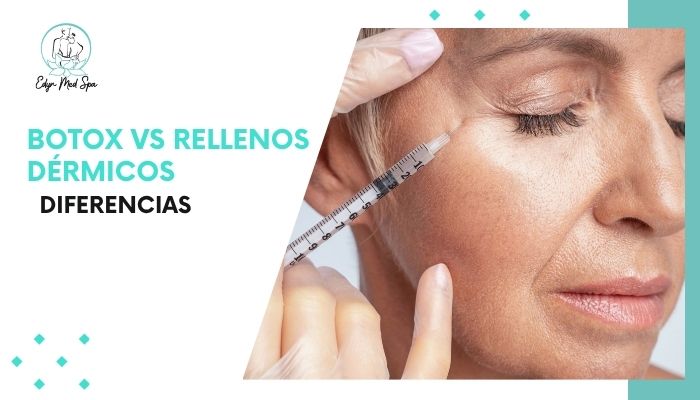
Botox vs dermal fillers: differences, uses, and how to know which one you need
When a client comes in asking for Botox, many times they don’t actually need Botox. And this happens more often than you might think.
It is very common to hear phrases like “I want Botox in the neck to fill,” “I need Botox in my lips,” or “I want Botox to restore volume to my face.” The problem is not the intention to improve appearance, but rather confusing two different treatments that work in completely different ways.
Understanding the difference between Botox and dermal fillers is key to choosing the right treatment, avoiding unrealistic expectations, and achieving a natural result. Although both are very popular injectables in aesthetic medicine, they do not serve the same purpose nor do they work in the same way.
Written by: Yunia Rodriguez, RMA (Registered Medical Assistant).
Last updated: April 22, 2026
Note: This content is for informational purposes only and does not replace a medical evaluation.
To find out if Botox is right for you and receive a personalized recommendation, call 305 900 7083 and schedule your free consultation at Edyn Med Spa.
What is Botox and what is it really used for?
The Botox, or botulinum toxin, is an aesthetic treatment that works by temporarily relaxing specific muscles. It is mainly used to soften wrinkles that appear due to repetitive facial movements, such as frowning, smiling, or raising the eyebrows.
It is especially useful for treating so-called dynamic wrinkles, such as forehead lines, frown lines, and crow’s feet. Its function is not to fill or add volume, but to reduce muscle contraction so the skin appears smoother and more rested.
What are dermal fillers and when are they recommended?
Dermal fillers, also known as fillers, are injectable treatments designed to restore volume, improve facial structure, and smooth folds or hollow areas. In many cases, they are made with hyaluronic acid, a substance widely used in aesthetic medicine for its ability to hydrate and provide support.
They are commonly applied to areas such as the lips, cheeks, nasolabial folds, marionette lines, chin, or jawline. Unlike Botox, dermal fillers do not relax muscles. Their purpose is to fill, add projection, or redefine specific areas of the face.
Botox vs filler: the most important difference
The main difference between Botox and dermal fillers is very simple to understand: Botox relaxes and fillers fill.
Botox:
- relaxes the muscle
- treats expression lines
- treats expression lines
- does not add volume
Dermal fillers:
- add volume
- smooth folds and hollow areas
- enhance facial contours
- work best when there is loss of support or wrinkles at rest
This is the reason why you shouldn’t use both terms as if they were the same. Although both are injectable treatments, the effect they produce is completely different.
Why many people confuse Botox with dermal fillers
This confusion usually occurs because both treatments are part of facial aesthetic medicine and are administered through injections. Additionally, Botox is a very popular term and is often used as a general word, even when the treatment the person actually needs is different.
It is also influenced by the fact that many patients do not distinguish whether their concern is a wrinkle caused by movement or an area with volume loss. At first glance, it may seem the same, but from an aesthetic perspective, it is not.
For example, a person may think they need Botox to fill a deep wrinkle or to add volume to an area of the face, when in reality what they need are dermal fillers.
What types of wrinkles does Botox treat?
Botox is mainly indicated for lines that form due to the repeated use of certain facial muscles. Among the most common are:
- forehead lines
- frown lines
- crow’s feet
These wrinkles tend to become more pronounced when making facial expressions. By relaxing the muscle, the skin stops folding as intensely and the expression softens.
What aesthetic concerns are commonly treated with dermal fillers?
Dermal fillers are used when the main issue is not muscle activity, but rather lack of volume, loss of structure, or the presence of more pronounced folds. They are commonly used to:
- add volume to the lips
- soften nasolabial folds
- improve marionette lines
- restore volume in the cheeks
- define the chin or jawline
- improve certain facial depressions
When a patient wants more projection, more support, or an improvement in facial contour, dermal fillers are usually the most appropriate option.
Botox or fillers: which may be better for you
It depends on the issue you want to treat.
Botox is usually a better option when:
- hay líneas de expresión marcadas
- wrinkles appear when making facial expressions
- the goal is to smooth the forehead, frown lines, or crow’s feet
Dermal fillers are usually more appropriate when:
- there is volume loss
- there are deep folds at rest
- the goal is to define the lips, chin, or jawline
- the goal is to restore facial structure
In many cases, the best answer is not Botox or fillers, but a personalized facial assessment to determine whether one of them or a combination of both is recommended.
Hyaluronic acid vs Botox: they are not the same
Another common question is comparing hyaluronic acid vs Botox as if they were equivalent treatments. They are not.
Botox works by relaxing the muscles responsible for dynamic wrinkles. Hyaluronic acid, when used as a dermal filler, adds volume, hydration, and support to specific areas of the face.
Each serves a different purpose, and both can be part of a well-designed non-surgical facial rejuvenation plan.
The importance of a professional assessment
Not all wrinkles are treated the same, and not all patients need the same approach. What may be resolved with Botox for one person may require dermal fillers, biostimulation, or a combined strategy for another.
A professional assessment allows for analyzing facial anatomy, the type of wrinkle, skin quality, and the desired outcome. This helps avoid common mistakes, such as requesting Botox for an area that needs volume or asking for fillers when the main issue is muscular.
Understanding the difference between Botox and dermal fillers helps people make better decisions and achieve more harmonious, natural, and balanced results for each face. Botox relaxes muscles to soften expression lines, while fillers add volume and enhance contours. When a patient understands this, they stop asking for a treatment by name and start choosing it for its true function. That is where a much better result begins.
Frequently Asked Questions
What is the difference between Botox and dermal fillers?
Botox relaxes muscles to soften expression wrinkles. Dermal fillers add volume and help correct folds, hollow areas, or lack of facial definition.
Which lasts longer, Botox or fillers?
It depends on the product, the treated area, and each person’s metabolism. In general, their duration is not the same and should be evaluated individually.
Does Botox fill wrinkles?
No. Botox does not fill. Its function is to relax the muscles that cause certain dynamic lines.
Are dermal fillers used for the forehead?
They are not usually the first option for expression lines on the forehead. In that area, the most common approach is often Botox, depending on a professional assessment.
Can I get Botox and fillers at the same time?
Yes, in many cases both treatments can be combined to address different facial needs in a complementary way.
What is better for lips, Botox or fillers?
Dermal fillers are typically used to add volume or define the lips, not Botox.
✨ Discover how much your ideal Botox costs
Get your personalized price in just seconds. It’s free! At Edyn Med Spa.
Initial Consultation and Personalized Care at Edyn Med Spa
At Edyn Med Spa, we believe that every client is unique, which is why we offer a completely free initial consultation. During this consultation, our team of experts will evaluate your needs and recommend a personalized treatment plan. Whether you are interested in facial treatments, therapeutic massages, or aesthetic rejuvenation, we ensure that you receive the specialized care you deserve.
Schedule your free consultation today! Call us at 305 900 7083 or send us a message to arrange your appointment.

Book an Appointment
Contact us to book an appointment!
We will respond to you shortly with confirmation.
